How Much Personal Loan Can I Get on My Salary? (Malaysia, RM2,000–RM8,000)
How much can you borrow on a RM2,000, RM3,000, RM5,000 or RM8,000 salary in Malaysia? Salary tables, the formula lenders use, and how existing commitments change the answer.
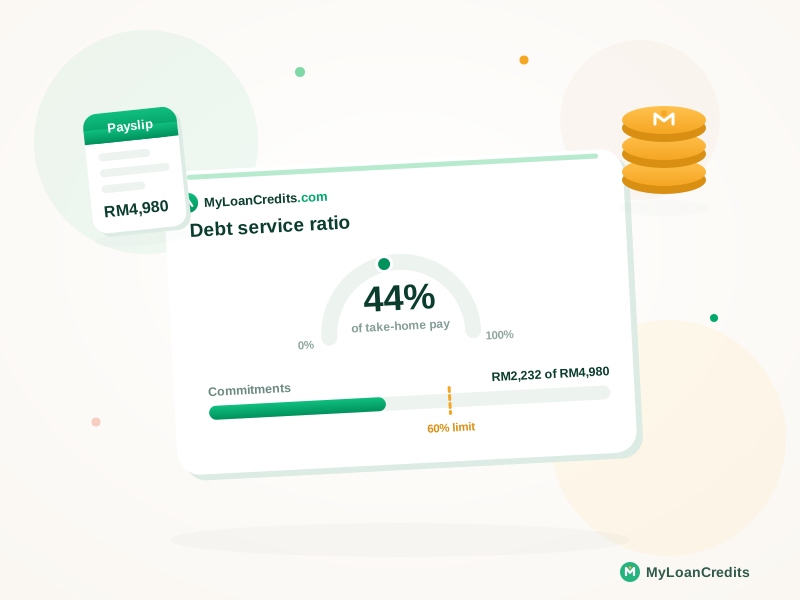
"How much can I borrow?" is the first question almost every applicant asks — and the honest answer is that your salary sets a ceiling, but your existing commitments decide how close to it you get.
This guide gives you realistic numbers for common Malaysian salaries, shows the arithmetic so you can run your own figures, and explains why two people on the same salary can be offered very different amounts.
The short version: salary tables
The tables below assume you have no other loans or credit card balances, and that the new instalment is kept to a sensible share of your net monthly income. Amounts are rounded down to the nearest RM100 and calculated at 12% p.a. on a reducing balance — the top of our rate range, so your actual figure at a lower rate would be higher.
Conservative — new instalment at 20% of net income:
| Net monthly income | Instalment | 3-year loan | 5-year loan |
|---|---|---|---|
| RM2,000 | RM400 | RM12,000 | RM17,900 |
| RM3,000 | RM600 | RM18,000 | RM26,900 |
| RM4,000 | RM800 | RM24,000 | RM35,900 |
| RM5,000 | RM1,000 | RM30,100 | RM44,900 |
| RM6,000 | RM1,200 | RM36,100 | RM53,900 |
| RM8,000 | RM1,600 | RM48,100 | RM71,900 |
Stretch — new instalment at 30% of net income:
| Net monthly income | Instalment | 3-year loan | 5-year loan |
|---|---|---|---|
| RM2,000 | RM600 | RM18,000 | RM26,900 |
| RM3,000 | RM900 | RM27,000 | RM40,400 |
| RM4,000 | RM1,200 | RM36,100 | RM53,900 |
| RM5,000 | RM1,500 | RM45,100 | RM67,400 |
| RM6,000 | RM1,800 | RM54,100 | RM80,900 |
| RM8,000 | RM2,400 | RM72,200 | RM100,000* |
*RM107,800 by the formula; RM100,000 is our maximum loan size.
These are not approval promises. They are the amounts the instalment arithmetic supports — a useful starting point before you speak to any lender.
Why it's about the instalment, not the salary
Lenders don't really ask "how much do you earn?" They ask "after this new instalment, how much of your income is already spoken for?" That ratio is your debt service ratio, or DSR:
DSR = (all monthly repayments, including the new loan) ÷ monthly income × 100
There is no single legal DSR cap in Malaysia — each lender sets its own — but most approvals happen somewhere in the 40%–60% range, and lower incomes are usually held to stricter limits. Our DSR calculator guide walks through which commitments count and how gross versus net income changes the result.
So the working method is always:
- Take your income (net, unless the lender tells you otherwise).
- Multiply by the DSR the lender is comfortable with.
- Subtract what you already pay each month.
- Whatever is left is the most the new instalment can be.
- Convert that instalment into a loan amount for your chosen tenure.
How existing commitments shrink the number
Here's the step most people skip. Take someone earning RM4,000 net with a RM600 car loan.
- At a 40% DSR, total repayments can be up to RM1,600 a month.
- The car loan already uses RM600, leaving RM1,000 for the new instalment.
- RM1,000 a month over 60 months at 12% p.a. supports about RM44,900.
Without the car loan, the same person could support RM1,600 a month — about RM71,900. One existing commitment cut their borrowing power by roughly RM27,000.
Credit cards matter too. Lenders typically count a share of your card limit or outstanding balance as a monthly commitment even if you pay in full, so a stack of high-limit cards you rarely use can quietly reduce what you're offered.
Converting an instalment to a loan amount
If you want to run your own numbers, this is the formula every lender uses for a reducing balance loan:
Loan amount = Instalment × (1 − (1 + r)^−n) ÷ r
where r is the monthly rate (annual rate ÷ 12) and n is the number of months.
For RM600 a month at 12% p.a. (r = 0.01) over 36 months: 600 × (1 − 1.01^−36) ÷ 0.01 ≈ RM18,064.
If formulas aren't your thing, the rule of thumb at 12% p.a. is:
- 3 years: the loan is about 30× the monthly instalment
- 5 years: the loan is about 45× the monthly instalment
Need a refresher on why the rate method matters? See flat rate vs reducing balance — a "low" flat rate changes these numbers considerably.
Five ways to qualify for more (without overreaching)
- Clear small balances first. Paying off a RM2,000 card balance or a nearly finished instalment plan can free up more borrowing power than it costs.
- Cancel cards you don't use. Unused limits can still count against you.
- Choose a longer tenure. The same instalment supports about half as much again over 5 years as over 3 — but you'll pay more interest overall.
- Show all your income. Regular allowances, commissions, rental income or a side business can count if they appear consistently in your bank statements. Self-employed? See our self-employed loan page.
- Ask for what you need, not the maximum. A realistic request is more likely to be approved quickly and is easier to live with.
Our list of practical ways to improve your approval chances covers the credit-report side of this in more detail.
The question to ask yourself
The maximum a lender will approve and the amount you should borrow aren't the same thing. Before applying, check the instalment against a normal month — not your best one — and make sure it still leaves room for savings and surprises.
See your real number
The tables give you a ballpark. Your actual figure depends on your exact income, commitments and rate. Apply in 3 minutes — checking doesn't affect your credit score, and you'll see the amount, rate and total repayment in writing before you sign anything.