DSR Calculator Malaysia: Work Out Your Debt Service Ratio
Calculate your DSR the way Malaysian lenders do — which commitments count, gross vs net income, what ratio gets approved, and how to bring a high DSR down.
Every loan application in Malaysia runs through the same filter before anyone looks at anything else: your debt service ratio, or DSR. It is the number that decides whether your application is worth assessing in detail — and it is the one number you can work out yourself, at home, in about five minutes.
This guide shows you how lenders calculate it, which commitments they count, why gross and net income give very different answers, and what to do when the number comes out too high.
What DSR actually measures
DSR answers one question: of the money that arrives each month, how much is already spoken for by debt?
The formula is simple arithmetic:
DSR = total monthly debt commitments ÷ monthly income × 100
If you earn RM5,000 a month and RM2,000 of it goes to repayments, your DSR is 40%. The remaining 60% is what you live on — and what a lender looks at when deciding whether you can absorb one more instalment.
Note what DSR does not measure. It ignores rent, groceries, childcare, insurance premiums and everything else that empties your account. A 45% DSR looks the same on paper whether you support four dependants or none. That is why lenders treat it as a screening tool rather than a verdict.
Which commitments count
Anything reported as a credit facility counts. In practice that means:
| Commitment | How it is usually counted |
|---|---|
| Home loan / financing | Full monthly instalment |
| Hire purchase (car) | Full monthly instalment |
| Personal loan | Full monthly instalment |
| PTPTN | Full monthly repayment |
| Credit cards | Commonly 5% of the outstanding balance, not your actual payment |
| Overdraft | A percentage of the limit or the outstanding amount |
| Buy-now-pay-later plans | Increasingly included as reporting improves |
| The new loan you are applying for | Always included — this is the step people forget |
Two of those rows deserve a closer look.
Credit cards are harsher than people expect. Many Malaysian lenders do not care that you clear your card in full every month. They apply a standard assumption — often around 5% of the outstanding balance — because the balance is what you could be carrying. RM10,000 spread across two cards can quietly add about RM500 a month to your calculated commitments.
The new loan counts. Your DSR before applying is not the number that matters. The number that matters is your DSR including the instalment you are asking for. Always calculate both.
Everything on that list appears in your CCRIS report, which is where the lender gets its figures. If you want to see exactly what they will see, pull your own report free from Bank Negara's eCCRIS portal before you apply.
Gross or net income? The difference is big
Here is where two lenders can look at the same person and reach different conclusions.
Gross income is your salary before deductions. Net income is what actually lands in your account after EPF, SOCSO and PCB (monthly tax deduction). For a typical Malaysian salaried employee, net income runs roughly 15%–20% below gross.
Banks operating under Bank Negara's responsible financing guidelines generally assess affordability on a net basis — the honest measure, because you cannot repay a loan with money that never reaches you. Some lenders quote DSR on gross income, which produces a smaller, friendlier percentage for exactly the same borrower.
Work it through with real numbers. Aisyah earns RM5,000 gross. After EPF (11%), SOCSO and PCB, RM4,150 reaches her account. Her commitments come to RM1,800 a month.
- On gross income: RM1,800 ÷ RM5,000 = 36%
- On net income: RM1,800 ÷ RM4,150 = 43.4%
Same person, same debts, seven percentage points apart. When a lender quotes you a DSR, ask which basis they used. When you calculate your own, use net — it is the number that reflects how the month actually feels.
A worked example
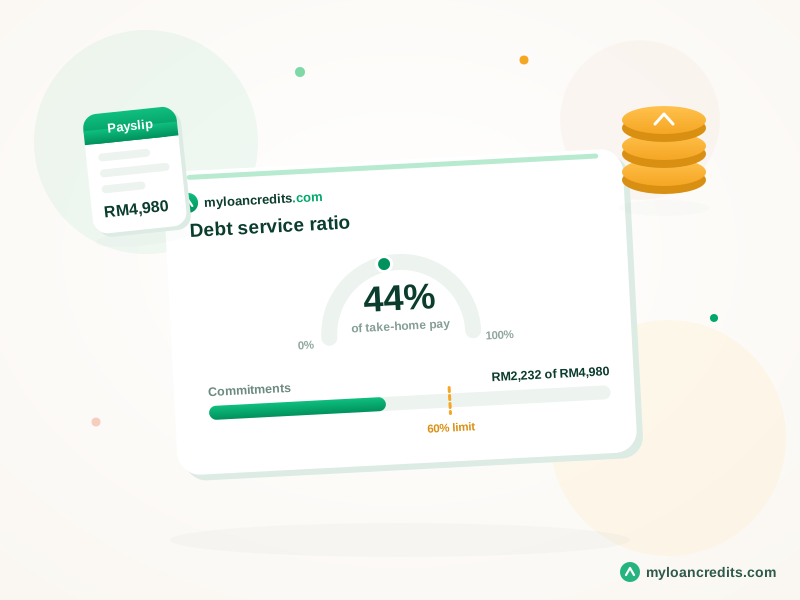
Meet Faizal. He earns RM6,000 gross, and RM4,980 net after deductions. His commitments:
| Commitment | Monthly |
|---|---|
| Car loan | RM850 |
| PTPTN | RM250 |
| Credit cards (RM8,000 outstanding × 5%) | RM400 |
| Existing total | RM1,500 |
His current DSR on net income is RM1,500 ÷ RM4,980 = 30.1%. Comfortable.
Now he wants RM30,000 over 48 months at 8% p.a. on a reducing balance, which works out to roughly RM732 a month.
- New commitments: RM1,500 + RM732 = RM2,232
- New DSR: RM2,232 ÷ RM4,980 = 44.8%
That is still within range for most lenders. But suppose Faizal stretched and asked for RM60,000 over the same tenure — an instalment near RM1,465. His DSR would land at 59.6%, right at the edge where lenders get cautious, and his approval odds drop sharply for an amount he did not really need. Borrowing the right size is a DSR decision, not just a budgeting one.
What ratio gets approved
There is no legal DSR cap in Malaysia. Each lender sets its own policy, but the working bands look roughly like this:
- Under 40% — comfortable. You have room, and the application turns on other factors.
- 40%–60% — the normal working range. Most approvals happen here, with repayment conduct and income stability deciding the outcome.
- 60%–70% — tight. Some lenders will still approve, often at a smaller amount or a longer tenure.
- Above 70% — difficult. Expect a decline or a substantially reduced offer.
Income level shifts these bands. A borrower earning RM3,000 at 60% DSR has RM1,200 left to live on; a borrower earning RM15,000 at the same ratio has RM6,000. Lenders know this, which is why lower income brackets are typically held to stricter limits. It is not a penalty — it is the same arithmetic you would do yourself.
Five ways to bring a high DSR down
If your number comes out higher than you would like, these are the levers that actually move it, roughly in order of speed:
- Pay down credit card balances. Because many lenders count 5% of the balance, clearing RM6,000 of card debt removes about RM300 a month from your commitments — far more leverage per ringgit than any other debt.
- Settle the smallest facility outright. Closing a RM200-a-month personal loan removes the full RM200. On a RM4,000 net income that is five percentage points of DSR.
- Take no new commitments before applying. A car bought three months before a loan application can quietly cost you the loan. Space out major credit decisions.
- Choose a longer tenure on the new loan. A smaller instalment means a smaller DSR — but remember that a longer tenure means more total interest, so use this deliberately rather than by default.
- Consolidate several debts into one. Replacing four instalments totalling RM1,350 with a single RM634 instalment transforms your DSR. Our guide to debt consolidation in Malaysia walks through the arithmetic and the traps.
If your DSR is high because you genuinely cannot meet current commitments, none of the above is the right tool. That is a case for AKPK's free debt counselling rather than another loan.
Before you apply
Run your own DSR twice — once as you are today, and once including the instalment you intend to ask for. If the second number lands under 60% on net income, you are applying from a reasonable position. If it does not, spend a few months on the levers above; the seven other steps in our guide to improving your approval chances compound with this one.
When your numbers are in shape, MyLoanCredits offers a personal loan from RM1,000 to RM100,000 over 6 to 60 months at 3.88%–12% p.a. on a reducing balance, with no early settlement penalty. Use the repayment calculator to find the instalment that keeps your DSR where you want it, then apply online — checking your options won't affect your credit score.