CCRIS vs CTOS Malaysia: What Lenders Actually See
CCRIS vs CTOS explained for Malaysia: what each report shows, how lenders read them, how to check both free, and how to fix errors before you apply.
Reviewed and updated by the MyLoanCredits editorial team.
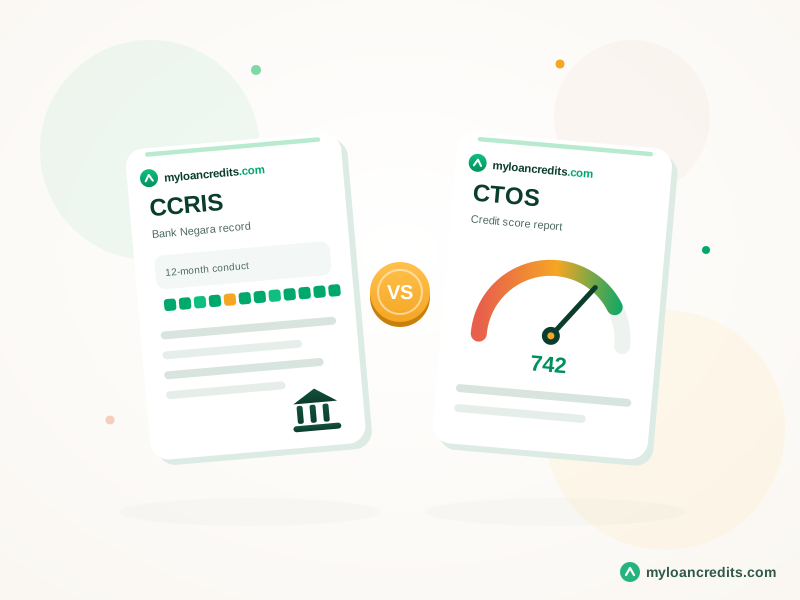
Apply for a loan in Malaysia and two names come up almost immediately: CCRIS and CTOS. Many people use them interchangeably, but they are different systems run by different organisations, and lenders read them in different ways.
Understanding both is one of the most practical things you can do before applying for any credit. Here is what each report contains, how a loan officer actually interprets it, and how to keep both working in your favour.
What is CCRIS?
CCRIS stands for the Central Credit Reference Information System, and it is operated by Bank Negara Malaysia (BNM). It collects credit information from banks and other participating financial institutions and compiles it into a factual report.
The key word is factual. CCRIS does not give you a score, a grade, or an opinion. It simply lays out your credit facilities and how you have been repaying them, and lets the lender draw its own conclusions.
A CCRIS report typically shows three things:
- Outstanding credit — your current facilities such as home loans, car loans, credit cards and personal loans, with balances and your repayment conduct over roughly the last 12 months.
- Special attention accounts — facilities that are under close monitoring, usually because of serious repayment problems or restructuring.
- Applications for credit — recent credit applications, whether approved or pending, which tells lenders how actively you have been seeking new borrowing.
That 12-month repayment record is the heart of the report. Each facility shows month-by-month whether payments were made on time or how many months in arrears the account was.
What is CTOS?
CTOS is a private credit reporting agency, one of several registered under Malaysia's credit reporting agency framework. Where CCRIS sticks to bank data, CTOS casts a wider net.
A CTOS report can include:
- The CTOS Score — a three-digit credit score that summarises your credit health, where a higher number generally signals lower risk.
- Legal and public records — court judgments, bankruptcy proceedings and similar records drawn from public sources.
- Trade references — records from non-bank businesses, such as unpaid bills a company has reported against you.
- Business interests — directorships and business ownership, which matters if you run or own a company.
- Banking payment history — CTOS reports also typically incorporate CCRIS data, so your bank repayment conduct shows up here too.
In short, CTOS tells a broader story: not just how you repay banks, but whether there are legal actions, unpaid trade debts or business exposures attached to your name.
CCRIS vs CTOS at a glance
| CCRIS | CTOS | |
|---|---|---|
| Run by | Bank Negara Malaysia | Private credit reporting agency |
| Credit score? | No — factual data only | Yes — the CTOS Score |
| Main content | Bank facilities, ~12-month repayment conduct, special attention accounts, recent applications | Score, legal records, trade references, directorships, plus CCRIS data |
| Data sources | Banks and participating financial institutions | Public records, businesses, and bank data |
| How to check | eCCRIS portal or BNM kiosks/branches — free | ctoscredit.com.my — basic access is free, fuller reports may be paid |
How lenders actually read your reports
When a bank or licensed lender assesses your application, they are usually asking three questions, and your reports answer all of them.
"Does this person pay on time?"
The CCRIS conduct record answers this directly. A clean row of on-time months is the strongest signal you can send. One late month from a year ago matters far less than a pattern of recent arrears — recency and consistency count.
"How stretched are they already?"
Lenders add up your existing commitments from CCRIS to estimate your debt service ratio (DSR) — roughly, how much of your income already goes to repayments. Lots of maxed-out facilities can hold back an application even if you have never missed a payment.
"Is there anything serious in the background?"
This is where CTOS earns its keep. A court judgment, bankruptcy record or string of unpaid trade references is a red flag no repayment history can offset. Lenders also glance at recent credit applications: many enquiries in a short window can suggest financial stress, which is one of the mistakes that quietly sink applications.
No single item usually decides the outcome. Lenders weigh the whole picture — but a problem you did not know about can quietly sink an otherwise strong application. That is why checking your own reports first matters.
How to check your own reports
CCRIS is free. You can register for BNM's eCCRIS portal online and view your report from home, or visit a BNM office or self-service kiosk in person. Checking your own CCRIS report does not hurt your credit standing, and there is no limit that should stop you from reviewing it before a big application.
CTOS reports are available at ctoscredit.com.my. Basic access, including a version of your score, is generally free once you register and verify your identity; more detailed reports may involve a fee. Again, checking your own report is a self-enquiry and is not treated the same way as a lender's credit check.
A sensible habit: review both reports a couple of months before any major application, so you have time to fix issues rather than discover them at the worst moment.
Common report problems and how to fix them
A payment shows as late, but you paid on time. Gather proof — statements or receipts — and raise it with the bank concerned. CCRIS data comes from the reporting institution, so corrections flow through them, not through BNM directly.
A settled loan still shows a balance. Ask the lender for a settlement letter and request that they update their reporting. Updates take a reporting cycle or so to appear, so allow a little time.
A legal record on CTOS is outdated or resolved. CTOS has a formal dispute process. Submit your supporting documents — for example, proof a judgment was satisfied — and the agency is required to investigate and correct genuine errors.
Facilities you don't recognise. Treat this seriously: it could be a reporting error or, worse, identity misuse — a common outcome after handing documents to an unlicensed lender. Contact the institution named on the report immediately and lodge a dispute in writing.
Habits that keep both reports clean
- Pay at least the minimum on every facility on or before the due date — automate it if you can.
- Keep credit card utilisation comfortably below the limit rather than riding at the maximum.
- Don't submit many credit applications in a short burst; space them out.
- Settle small disputes (telco bills, subscriptions) before they escalate into trade references or legal action.
- Check CCRIS and CTOS at least once a year, and always before a major loan application.
None of this is glamorous, but twelve quiet months of on-time payments will do more for your applications than any quick fix. If your reports show more commitments than you would like, our guide to debt consolidation in Malaysia covers one way to tidy them into a single repayment. You can also read how lenders assess applications on our how it works page, or browse common questions in our FAQ.
Ready when your reports are
If you are considering a personal loan, MyLoanCredits offers financing from RM1,000 to RM100,000 over 6 to 60 months, at rates between 3.88% and 12% p.a. on a reducing balance — and submitting an enquiry doesn't affect your credit score. When your CCRIS and CTOS are in order, you can apply online in minutes and put those clean reports to work.