Emergency Fund or Emergency Loan? A Practical Decision Guide
Unexpected bill in Malaysia? Learn when to use your emergency fund, when a loan makes sense, and how to compare your options calmly and honestly.
Reviewed and updated by the MyLoanCredits editorial team.
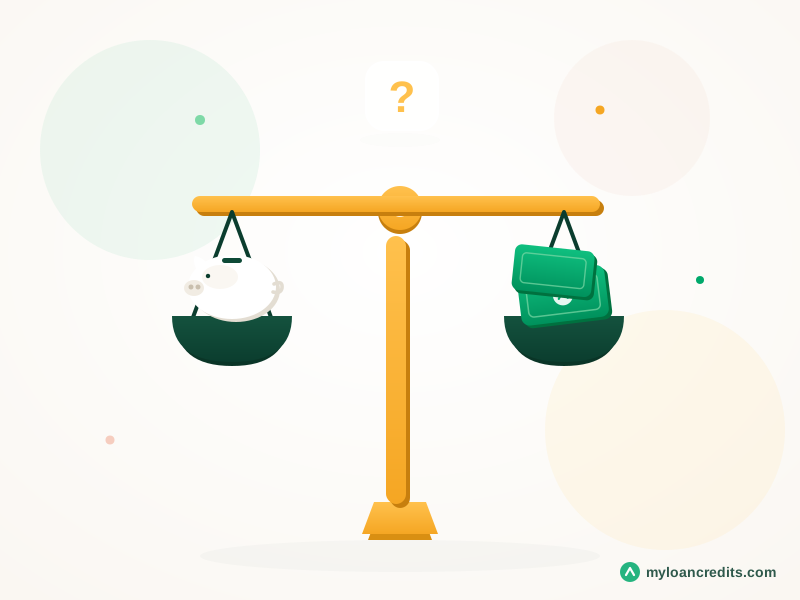
The hospital bill arrives. The car won't start on a Monday morning. A family member calls and genuinely needs help. Whatever form it takes, an unexpected expense has a way of showing up at the worst possible time — and the question is always the same: where does the money come from?
There are really only two honest answers: money you already have, or money you borrow. This guide walks through both, without pretending one of them is always right.
Plan A is always the emergency fund
Before we talk about borrowing, let's be clear: an emergency fund is the best financial shock absorber ever invented. It costs you nothing in interest, requires no approval, and is available the moment you need it.
The classic target is 3 to 6 months of essential expenses — rent or mortgage, food, utilities, transport, insurance, and minimum debt payments. If your essentials come to RM3,000 a month, that means RM9,000 to RM18,000 set aside.
If that number feels impossible right now, don't let it stop you from starting. A mini-fund of RM1,000 is a genuinely useful first milestone. It won't cover a major surgery, but it will absorb a burst tyre, a broken phone, or a clinic visit — the small emergencies that push many people into debt in the first place.
Where should it live? Somewhere safe, separate, and reachable within a day or two:
- A separate savings account (not your daily spending account)
- A fixed deposit you can break if needed, or a money market fund
- Not in stocks, crypto, or anything that can be down 30% the week you need it
The key word is separate. Money you can see in your everyday account has a way of getting spent.
When borrowing is a reasonable choice
Life doesn't wait for your savings to catch up. Sometimes the emergency arrives before the fund does, and in that situation, borrowing can be a rational decision rather than a failure. It's usually reasonable when all four of these are true:
- It's a true emergency. The expense is urgent, necessary, and can't be delayed or reduced — a medical procedure, a car repair you need to earn your income, an urgent family obligation.
- You don't have a fund yet (or the emergency is bigger than the fund). If you have the cash, use the cash — savings are cheaper than any loan.
- The cost of not acting is higher than the cost of borrowing. A delayed medical treatment that gets worse, a car problem that costs you your job, a late payment that snowballs into penalties — sometimes inaction is the expensive option.
- The repayment fits your budget. You've looked at the monthly instalment and it fits alongside your existing commitments without pushing you into survival mode.
When borrowing is not the answer
Just as important is being honest about when a loan will make things worse:
- Wants dressed up as needs. A festive sale, a holiday, a phone upgrade — these can feel urgent, but urgency you feel is not the same as urgency that exists.
- Borrowing to invest. If someone promises returns that will "easily cover the interest", walk away. Leveraging into investments with borrowed emergency money is how small problems become big ones.
- You're already stretched. If your existing repayments already eat a large share of your income — check your debt service ratio if you are unsure — adding another loan doesn't solve the emergency; it delays and enlarges it. In that situation, talk to your bank, your employer, or a free credit counselling service such as AKPK before taking on more debt.
Comparing your options honestly
When the money has to come from somewhere, you usually have a handful of choices. Each has real trade-offs:
| Option | Speed | Cost | Main trade-off |
|---|---|---|---|
| Emergency savings | Immediate | Free | Fund needs rebuilding afterwards |
| EPF flexible/Account 2 withdrawal (where eligible) | Days, if you qualify | No interest, but lost retirement growth | Reduces your future retirement savings; strict eligibility rules |
| Family or friends | Fast | Usually free | Can strain relationships; repay it like a real debt |
| Credit card | Instant | High interest if not cleared quickly | Easy to let a balance linger for years |
| Personal loan | Often 1–3 days | Fixed interest, predictable instalments | You're committing to monthly repayments for the term |
A few notes on that table:
- Savings first, always. It's the cheapest money you'll ever use.
- EPF withdrawals may be an option for certain purposes and account types, but the rules and eligibility vary — check the official EPF channels before counting on it. Remember that money withdrawn today is money not compounding for your retirement.
- Family help can be the kindest and cheapest option, but treat it with the same seriousness as a bank loan: agree the amount, the timeline, and stick to it.
- Credit cards are fine for short gaps you can clear in full next statement. As a months-long emergency solution, the interest adds up fast — and once several balances build up, consolidating them becomes the next problem to solve.
- Personal loans give you a fixed instalment and a clear end date, which makes budgeting easier — but only if the instalment genuinely fits.
If you do borrow: size it right, keep it short
Two habits separate a sensible emergency loan from a regretted one.
Borrow the gap, not a round number. If the repair costs RM4,300 and you have RM1,800 saved, the amount you need is RM2,500 — not RM5,000 "to be safe". Every extra ringgit borrowed is a ringgit paying interest for no reason.
Keep the term as short as your budget allows. A longer term means smaller monthly instalments, which feels comfortable — but you pay interest for longer, so the total cost rises. Check whether the rate you are quoted is flat or reducing balance before you compare offers. Choose the shortest term where the instalment still fits your budget without strain. And if your lender has no early settlement penalty, pay it off ahead of schedule whenever you can.
After the storm: rebuild the fund
Once the emergency has passed, the final step is the one most people skip: rebuilding.
- Restart (or start) an automatic transfer to your emergency savings on payday — even RM100–RM200 a month rebuilds momentum.
- Aim for the RM1,000 mini-fund first, then work towards one month of expenses, then three.
- If you took a loan, once it's cleared, redirect that same instalment amount straight into savings. You've already proven you can live without it.
The goal is simple: the next emergency should meet a fund, not a lender.
Need to bridge the gap responsibly?
If you've worked through this guide and a loan is genuinely the right tool for your situation, MyLoanCredits offers personal loan financing from RM1,000 to RM100,000, over 6 to 60 months, at 3.88%–12% p.a. — with funds in as fast as 24 hours and no early settlement penalty, so you can clear it early without extra cost. You can see exactly how the process works on our how it works page, check common questions in our FAQ, or apply online in minutes when you're ready.